Context
01 – Challenge
02 – What DID I Do
03 – Learnings
Student project
How might we design a simple platform that connects local producers with nearby residents and makes local products visible?
I was involved in the entire project process, from user research and interviews to ideation, Figma prototyping, and usability testing.
Initially, the project scope and direction were uncertain. Research, interviews, and usability testing clarified real user needs.

→
Interviews and Personas
Testing Core Flows

→
For our project, we selected the village of Rickenbach as a starting point. Local providers were systematically identified and visualised on this map. Farm shops are especially prominent, reflecting their importance within the local economy, which this project aims to support.


→
By visiting existing farm shops, we can observe how design and presentation influence the shopping experience. Colour choices and visual design play a central role in shaping atmosphere and perception, affecting how products are noticed, understood, and valued within the space.


Typeface & Color
A warm palette built around dark brown and soft orange tones reflects local production and craftsmanship. An off-white is used to balance the scheme, providing clarity and sufficient contrast.
Bogart is used for expressive, characterful headlines, while LL Circular serves as a clean and highly legible typeface for body text. Together, they create a visual language that is approachable yet structured.


→
For the prototype, we prioritised the user interface and the operational processes of producers and suppliers. This allowed us to structure key interactions and present essential workflows in a coherent user experience.

→
Starting with basic layout and task flow exploration, the prototype progressively introduced visual design, refined interactions, and clearer task handling, resulting in a cohesive UI that supports realistic workflows for producers and suppliers.

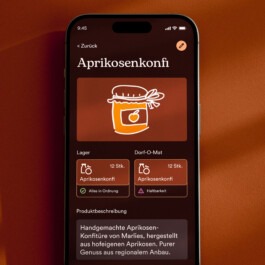
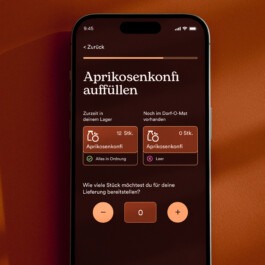
A local producer, Bernd Bauer, has prepared extra apricot jam for the Dorf-O-Mat and now wants to restock the shop.

To register his products in the system, Bernd attaches a QR code label to each jar. He can download and print these codes online.


Bernd can scan, register, and manage his products directly in the system using his smartphone, right on site and without detours.

Greta loves farm shops, supports local projects, and helps with deliveries when producers cannot restock themselves.
→
Color contrasts, icons, and status indicators were carefully chosen so that information remains clear and distinguishable for users with protan (red-blind), deutan (green-blind), and tritan (blue-blind) vision. This ensures that critical states such as availability, warnings, and actions are communicated reliably, independent of color perception.

→
The user interfaces are designed to ensure sufficient contrast at all times, providing clear legibility across different lighting conditions and device settings. Text, icons, and interactive elements remain easy to distinguish, supporting comfortable and reliable use for all users.

→
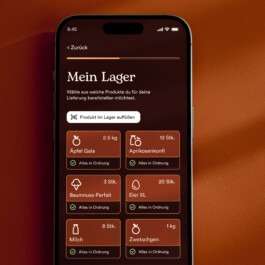
The final UI ties together overview, refill, and product details into one coherent system. Producers can check the situation, adjust quantities, and react to quality signals with minimal steps. The result is a practical tool that reduces friction in restocking and supports reliable local supply through the Dorf-O-Mat.


Collaboration
Disciplines
Arwen Bättig and
Dario Stocker

Concept
Local producers are connected directly with nearby residents through a digital platform.
CHALLENGE
How might we design a simple platform that connects local producers with nearby residents and makes local products visible?
MY ROLE
I was involved in the entire project process, from user research and interviews to ideation, Figma prototyping, and usability testing.
LEARNINGS
Initially, the project scope and direction were uncertain. Research, interviews, and usability testing clarified real user needs.
As part of a module at Lucerne University of Applied Sciences and Arts, developed in collaboration with Swiss Post, we designed Dorf-O-Mat, a platform connecting local producers with nearby residents. With Arwen Bättig and Dario Stocker, we researched user needs, built and tested prototypes, and iterated towards a practical solution.


Location